
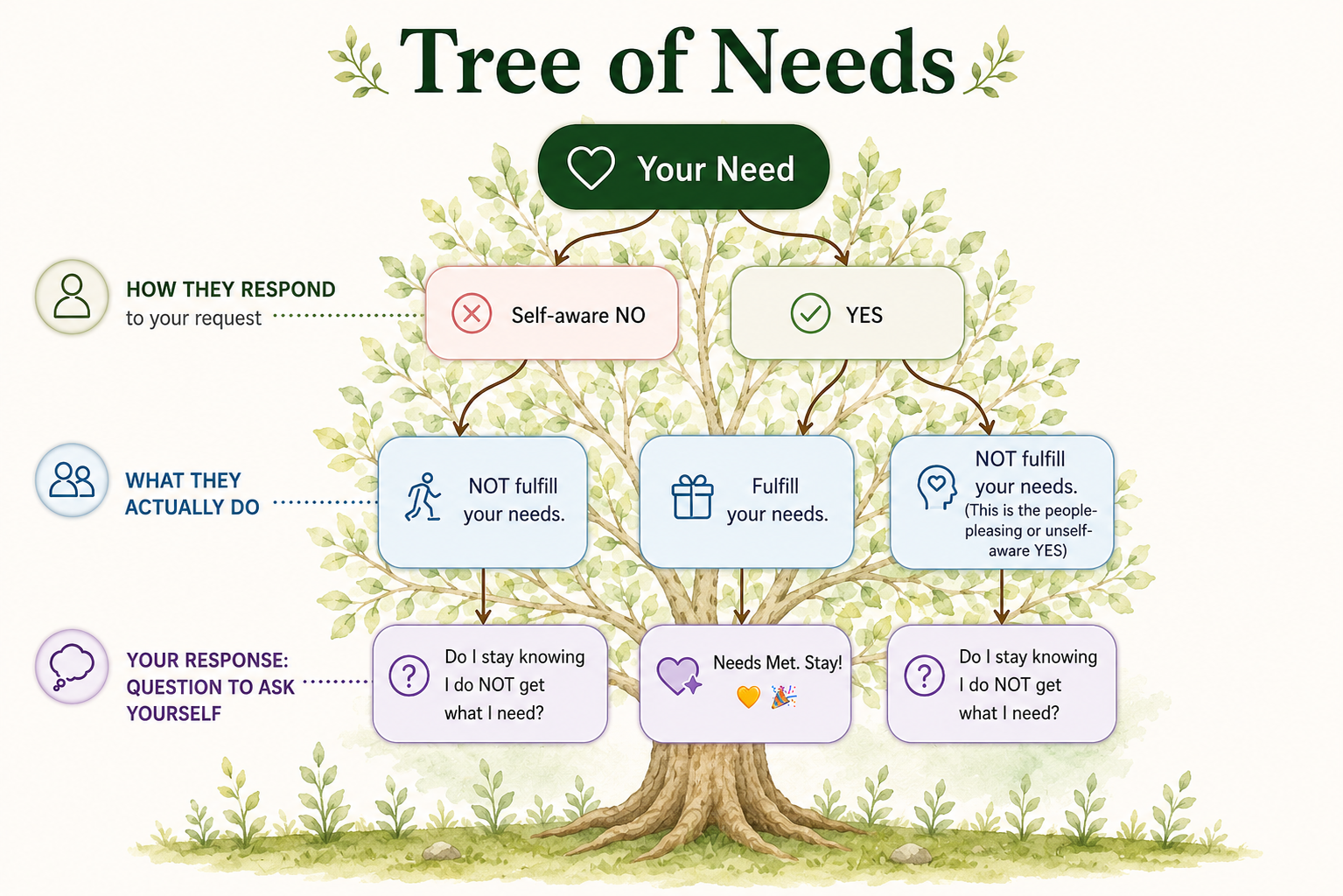
If you’ve ever wondered, when dating someone, “How do I express my needs and then decide if it’s a relationship I still want to be in?” I have a framework I’d like you to consider: The Tree of Needs. At the top, we have your need, whatever that may be. On the next rung, we have the other person’s verbal response to you expressing your need: No or yes. On the next rung, we have their behavior after the response, and on the next rung, we have your response to their behavior. (It’ll become clearer with an example.)
Let’s say you’re in a new relationship, or any relationship, and you have a need that’s not getting fulfilled.
For example, let’s say Susan only sees Parker once a week, but she would really prefer to see him more than that. She says, “Hey Parker, I would love to see you more than once a week!” A simple, reasonable request. Then, Parker can do one of two things: say yes or no. We are at the top level of our tree right now. If Parker says no at this point, I call this the “self-aware no” because he knows it’s something he cannot or will not fulfill, and he is being honest about it. He says no, and, in turn, does not fulfill Susan’s needs. At this point, knowing that she does not get her needs met (as in, she still won’t see him more than once a week), it’s up to Susan to decide whether to stay or go. (We can obviously substitute “see each other once a week” with anything, like texting more, giving more verbal reassurance, etc.) This is the bottom left of the diagram.
Then on the other path, if Parker says yes at this point, then great! If after this yes, Susan does, in fact, get her needs met (they’re seeing each other twice a week now… yay!), then she’ll be thrilled that she asked for what she wanted when she did.
The last scenario, of course, is that Parker says yes, but continues not to fulfill Susan’s needs. I call this either the “people pleasing” or the “unself-aware” option because he did say yes but is unable to give Susan what she wanted. In essence, he told her what she wanted to hear, or, possibly, he actually thought he could do it but really can’t.
Internally, this might look to Parker like, “I’m pretty sure I don’t have the capacity to see each other more than once a week due to work and my kids’ schedules, but I’m going to say yes to make everyone happy. I know it’s what Susan wants. Plus, if I say no, she may not stick around. Let’s keep the peace.” This is people-pleasing Parker. (Say that five times fast.)
Or, it might look like, “Yes, I can definitely see Susan a few times a week! I can juggle some things around to make it happen.” But, he can’t actually do that. He has commitments, and it was wishful thinking that he could create more time when there is none. This is unself-aware (though well-intentioned) Parker.
In the end, though, this “yes” does not lead to seeing each other more than once a week, and again, Susan finds herself in the predicament of deciding whether to stay or go knowing that she doesn’t get what she wants… yet still heard “yes.” We are now at the bottom right of the diagram.
To put it simply, you state your needs, the other person says yes or no, and depending on both their answer and the subsequent behaviors, you decide if you want to stay or go.
Using a bit of tough love, I promise you this: If you bring up your needs to your partner or the person you’re dating, your relationship may break, which is a risk, of course, if they can’t satisfy or won’t satisfy your needs. But if you don’t bring up your needs because you’re playing it cool, or you’re afraid, or you’re living in the status quo, I promise you, your relationship will break, or more likely, you will.